



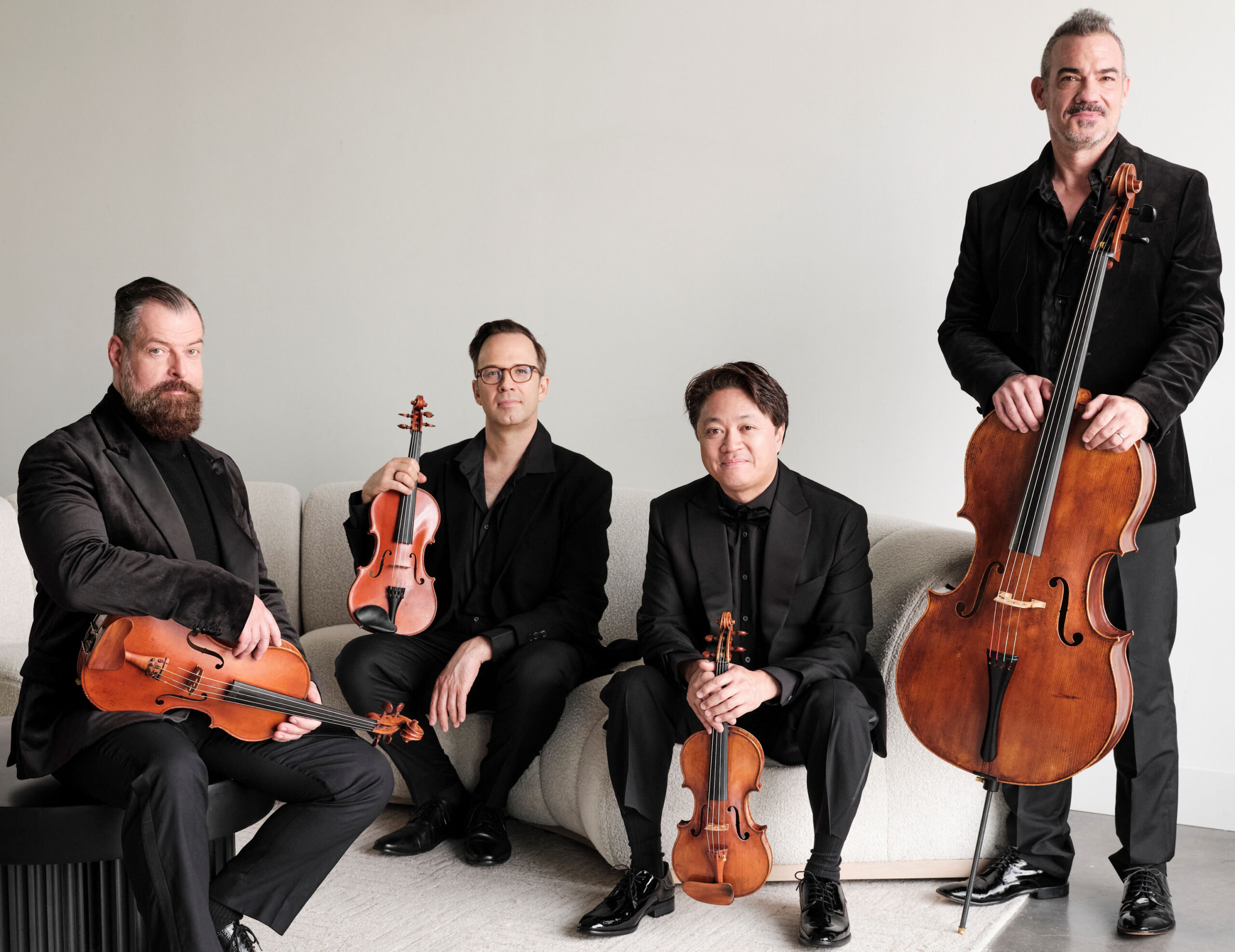
The Miró Quartet is one of America’s most celebrated string quartets, praised as “furiously committed” by The New Yorker and recognized for its “exceptional tonal focus and interpretive intensity” by the Cleveland Plain Dealer. For nearly 30 years, the GRAMMY®-nominated quartet has performed on the world’s most prestigious concert stages, earning accolades from critics and audiences alike.
The concert is followed by a reception where you can meet the artists.
All are encouraged to attend.
This concert is generously sponsored by
Michael McGarvey
Joseph Haydn (1732–1809)
String Quartet in D major, Op. 71, No. 2, Hob. III:70
Caroline Shaw (b. 1982)
Entr’acte
Anton Webern (1883–1945)
Langsamer Satz
Antonín Dvořák (1841–1904)
String Quartet No. 12 in F major, Op. 96, “American”
String Quartet in D major, Op. 71, No. 2, Hob. III:70
Joseph Haydn composed his D major, Op. 71, No. 2 string quartet in 1793, during the period between his two extended visits to London. The work belongs to a group of six quartets (Opp. 71 and 74) commissioned by Johann Peter Salomon, the impresario who had arranged Haydn’s first tour in London. Before his trip, Haydn had spent 24 years in the service of the Esterházy family, living primarily at the Esterháza estate in rural Hungary. The death of Prince Nikolaus Esterházy in 1790 and the succession of his son Anton changed the composer’s circumstances significantly. Although Haydn remained nominally employed at Esterháza, the orchestra he managed was disbanded, leaving the composer considerably freer to pursue opportunities abroad. After more than two decades living in relative isolation, this was a welcome change for Haydn.
In 1791 at the age of fifty-eight, Haydn went to London, where the already revered composer’s music received extensive public attention. The Op. 71 and Op. 74 quartets were written in connection with his burgeoning international career and were intended for performance before London’s larger audiences and larger concert halls on his second visit in 1794–95. He returned to Vienna after 1795 and continued composing until the final years of his life, dying there in 1809 at the age of seventy-seven.
Entr’acte
Caroline Shaw is an American composer, violinist, and singer whose impressive and wide-ranging collaborations span from contemporary classical ensembles like Sō Percussion and Roomful of Teeth to popular music artists like Phoebe Bridgers and Rosalía. She has received numerous commissions and awards for her compositions, including the 2013 Pulitzer Prize for Music, making her the youngest ever recipient of the award. Her compositions encompass vocal, chamber, orchestral, pop, and film music genres and she maintains an active performing career as a violinist and singer.
Caroline Shaw composed Entr’acte in 2011 for the Brentano String Quartet (fourteen-time guest artists at the Howland Chamber Music Circle), which gave its premiere performance at Princeton University in April of that year. Shaw wrote the piece after she heard the Brentano String Quartet perform Haydn’s Op. 77, No. 2 string quartet (which Brentano performed at the Howland Center in September of 2010 — possibly the same season Shaw first heard their interpretation). Shaw’s work draws inspiration from the distinctive and rather unusual-for-the-time shift from F major to D-flat major at the top of the trio section of Haydn’s minuet. Entr’acte takes the eighteenth-century minuet-and-trio form as a point of departure. Shaw adapted the quartet for string orchestra for the Boston-based ensemble A Far Cry in 2014, and it has become one of the most-programmed works for string orchestra of the last decade.
Langsamer Satz
Anton Webern composed Langsamer Satz for string quartet in 1905, when he was twenty-one years old and had just begun his studies with Arnold Schoenberg in Vienna. While Schoenberg proved in time to be Webern’s most influential teacher, this early quartet only hints at the atonality and succinct, compressed gestures that came to define the Second Viennese School of which Schoenberg and Webern were pioneers.
Sounding more akin to the music of Brahms, Langsamer Satz was inspired by a hiking trip the young Webern took with his cousin Wilhelmine Mörtl, whom he later married. The piece was initially intended as part of a projected four-movement string quartet, but Webern did not complete that larger work and did not publish Langsamer Satz during his lifetime. Its musical language belongs to the late-Romantic period of his development and predates his first numbered opus, the Passacaglia for orchestra, completed in 1908.
It wasn’t until the 1920s that Webern adopted Schoenberg’s twelve-tone method and developed it with an increasingly concentrated approach to musical form and duration. Webern’s music was not well known during his lifetime, though its brutal angularity garnered newfound interest in the wake of World War II. The manuscript of Langsamer Satz was rediscovered in the early 1960s by musicologists Hans and Rosaleen Moldenhauer and received its first known public performance by the University of Washington String Quartet in May 1962, seventeen years after Webern’s death.
String Quartet No. 12 in F major, Op. 96
Even though Czech composer’s Antonín Dvořák greatest hits are so closely associated with America — the “American” Quartet (String Quartet No. 12 in F major, Op. 96) and his “New World Symphony” (Symphony No. 9 in E Minor) for example — Dvořák in fact spent only three years in the United States.
Dvořák came to the United States in 1892 to serve as director of the National Conservatory of Music in New York, a position he held until 1895. He composed his No. 12 in F major, Op. 96 quartet, during the summer of 1893 while living in Spillville, Iowa, a small community founded largely by Czech immigrants. Dvořák vacationed with his family in Spillville that summer at the recommendation of the composer’s private secretary, Josef Kovařík, who grew up in the town. The work was written shortly after his ninth symphony and was followed by the String Quintet in E-flat major, Op. 97. Dvořák acknowledged that his experiences in America affected his music during this period, though he claims not to have directly quoted American melodies in these works.
The composer himself didn’t coin the moniker “American” Quartet; the nickname likely originated as a way to distinguish this quartet from his earlier, more European-sounding works. After returning to New York, Dvořák continued his duties at the National Conservatory and witnessed the successful premiere of his “New World Symphony” at Carnegie Hall in December of that year. He returned permanently to Bohemia in 1895, and died in Prague in 1904 at the age of sixty-two.
The Miró Quartet is one of America’s most celebrated string quartets, praised as “furiously committed” by The New Yorker and recognized for its “exceptional tonal focus and interpretive intensity” by the Cleveland Plain Dealer. For nearly 30 years, the GRAMMY®-nominated quartet has performed on the world’s most prestigious concert stages, earning accolades from critics and audiences alike. Based in Austin, TX, and thriving on the area’s storied music scene, the Miró takes pride in finding new ways to communicate with audiences of all backgrounds while cultivating the longstanding tradition of chamber music. Miró Quartet’s recent and upcoming projects include a touring and recording project with pianist Lara Downes titled Here on Earth, featuring musical depictions of our planet, its evolution, and the lives of its inhabitants; the premiere of a new version of Kevin Puts’ Credo with the Naples Philharmonic; and collaborations with composers Steven Banks, Tamar-Kali, and Gabriel Kahane, as well as soprano Karen Slack. Having independently released many celebrated recordings for a variety of global labels, the Miró Quartet was nominated for a 2025 GRAMMY® Award for Best Chamber Music/Small Ensemble Performance for its second album on Pentatone, Home, featuring two new commissions by Kevin Puts and Caroline Shaw, as well as works by George Walker and Samuel Barber.
It was nominated for a 2024 GRAMMY® Award for Best Choral Performance for House of Belonging, created in collaboration with Austin-based choral group Conspirare. The quartet recently produced an Emmy Award-winning audiovisual multimedia project titled Transcendence, a documentary centered around a performance of Franz Schubert’s Quartet in G Major on rare Stradivarius instruments, available on livestream, CD, and Blu-ray. Formed in 1995, the Miró Quartet was awarded first prize at several national and international competitions including the Banff International String Quartet Competition and the Naumburg Chamber Music Competition. Deeply committed to music education, members of the Quartet have given master classes at universities and conservatories throughout the world, and since 2003 has served as the quartet-in-residence at the University of Texas at Austin Sarah and Ernest Butler School of Music. In 2005, the Quartet became the first ensemble ever to be awarded the coveted Avery Fisher Career Grant. The Miró Quartet took its name and its inspiration from the Spanish artist Joan Miró, whose Surrealist works — with subject matter drawn from the realm of memory, dreams, and imaginative fantasy — are some of the most groundbreaking, influential, and admired of the 20th century.